
Airlines are fitting Starlink Wi-Fi because it changes the two numbers that define cabin internet: latency and installation time. The low-earth-orbit constellation orbits a few hundred kilometers up, cutting round-trip signal delay to a level where video calls feel normal, and the flat-panel terminal installs in a single overnight maintenance window, per the carriers' own retrofit announcements. Since Hawaiian Airlines flew the first Starlink-equipped commercial flights in early 2023, the retrofit list has grown to include United Airlines — which began installing the system on mainline jets in 2025 per its announcement — alongside Air France and a run of regional carriers.
What makes Starlink different from older satellite Wi-Fi?
Traditional in-flight satellite systems talk to spacecraft parked 35,786 kilometers above the equator in geostationary orbit. The signal is workable but the round trip — aircraft to orbit to ground station and back — adds several hundred milliseconds of latency, which is why video calls stutter on older equipment.
Starlink's spacecraft sit roughly 550 kilometers up. The physics cut delay by more than half, into the range where interactive applications behave as they do on the ground. Capacity is the second difference: each LEO satellite covers a small moving cell, and frequency reuse across thousands of spacecraft multiplies the bandwidth available to any one aircraft, as the service provider's published specifications describe.
Related stories: How In-Flight Wi-Fi Works: Air-to-Ground, Ku-Band and Ka-Band Satellite Explained · Predictive Maintenance: How Airlines Fix Aircraft Before They Break.
Why do airlines like the retrofit economics?
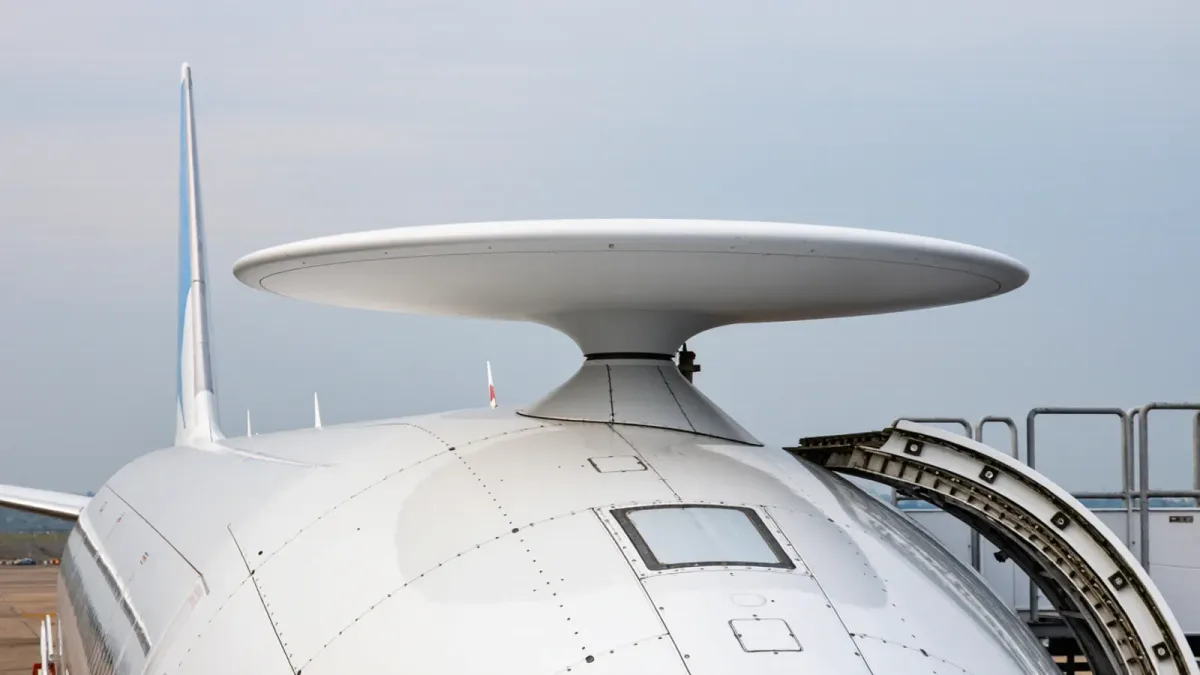
The antenna is the story. Geostationary systems need a mechanically or electronically steered radome that adds weight and drag, and an installation can take an aircraft out of service for days. The Starlink terminal is a fixed flat-panel array under a low-profile radome; the carriers' announcements describe overnight installations — one maintenance night per aircraft. United's program, announced in 2024 and begun on mainline aircraft in 2025, leaned on exactly that math, with the airline stating installations at its own facilities.
The commercial terms also stand out: several U.S. carriers announcing Starlink deals have bundled the service free for all passengers on the equipped fleet rather than charging per session, treating Wi-Fi as a loyalty and experience investment funded by the agreement rather than a per-flight product.
What changes for the traveler onboard?
In practice: gate-to-gate coverage on equipped aircraft, streaming that works, video calls in the cabin, and messaging that never drops handoffs. Gate-to-gate operation requires the airline's installation to be approved for all flight phases — retrofit aircraft flying with Starlink have operated connected from departure gate to arrival gate per the carriers' service descriptions.
The caveats: coverage over oceans and poles follows the constellation's ground-station map and improves as laser-linked satellites extend service over water; and fleet transitions take years — a carrier with hundreds of aircraft will fly mixed equipment through the retrofit period, so the aircraft type and tail matter more than the airline's logo when predicting your connection quality. Check the equipment note on your booking before assuming the new system is on your specific flight.