
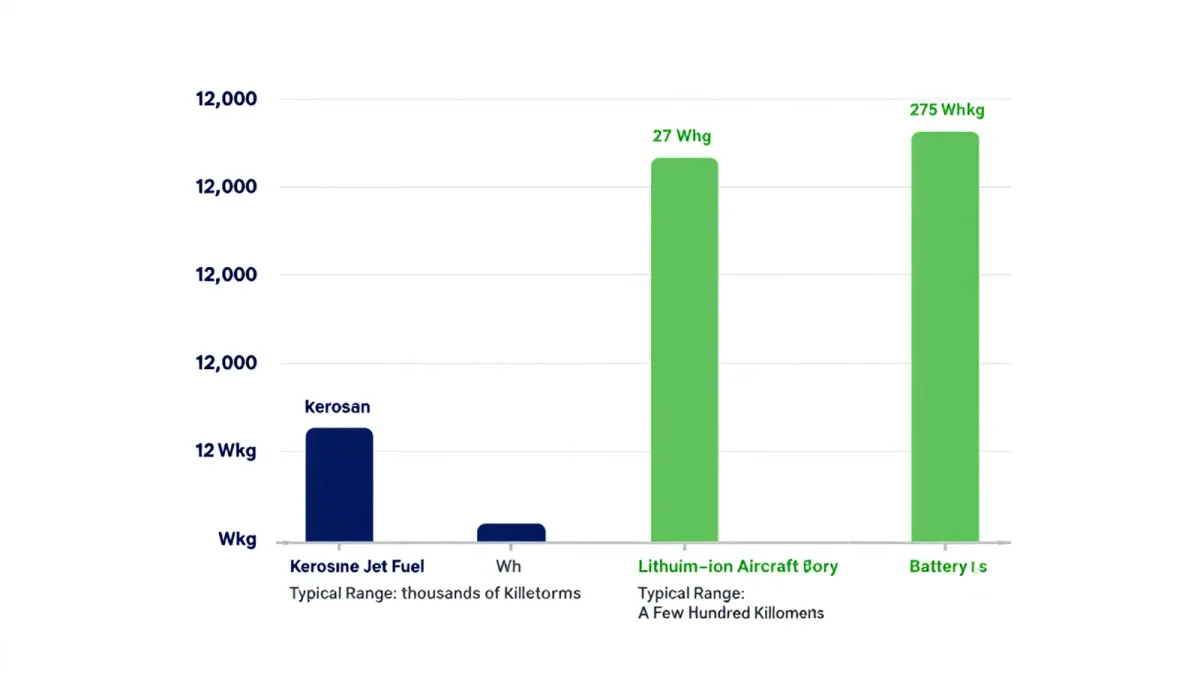
Electric airliners remain a chemistry problem: today's best aviation-certifiable lithium-ion batteries store roughly 250-300 watt-hours per kilogram, while kerosene holds about 12,000 Wh/kg — a factor of forty that no airframe design can ignore. That arithmetic is why realistic electric service starts on short hops: certified two-seat trainers already fly, and the first commuter-class programs — beginning with the 9-seat, 250-kilometer-range Heart Aerospace ES-30 concept and the 30-seat regional designs in development — target certification late this decade, per the manufacturers' program timelines.
Why does the energy gap matter so much in the air?
A jet airliner burns most of its fuel and lands lighter; an electric aircraft lands carrying every kilogram of battery it took off with. That asymmetry eats range: analyses across academic and manufacturer studies converge on electric useful ranges of a few hundred kilometers at commuter scales, versus thousands for a turboprop on the same weight budget. Climbing is the worst case — an aircraft spends disproportionate energy gaining altitude, so short hops consume proportionally more than cruise alone suggests.
The mitigation is hybridization. Gas-electric designs use batteries for taxi, takeoff, and climb, then cruise on generator or turbine power — capturing the emissions cuts where fuel burn concentrates without betting range on today's cells. Heart Aerospace's earlier ES-30 design spelled this out explicitly: 200 kilometers battery-only, extending to roughly 400 with a hybrid range-extension module, per the company's published specifications.
Related stories: What Sustainable Aviation Fuel Is, and Why Supply Reaches Only About 1% of Demand · How In-Flight Wi-Fi Works: Air-to-Ground, Ku-Band and Ka-Band Satellite Explained.
What is actually certified and flying?
- Certified two-seat trainers: the Pipistrel Velis Electro won EASA type certification in 2020 — the first certified electric aircraft — and flies at flight schools in Europe, per EASA's validation record.
- Commuter programs: 9-to-30-seat designs are in development with certification targets between 2028 and the early 2030s, per the manufacturers' stated timelines.
- eVTOL air taxis: a parallel track — the FAA and EASA continue certification work on electric vertical-takeoff designs, with first passenger-carrying operations expected this decade at short urban ranges.
The pattern across every track is the same: certification effort, not battery breakthroughs, sets the near-term dates. New categories of aircraft move through regulator review on five-to-eight-year timelines even when the hardware is ready.
What would a battery breakthrough change?
A credible 500-800 Wh/kg cell chemistry — solid-state programs' stated targets — would roughly double to triple practical electric ranges, putting regional cities a state apart within reach. Aviation's certification caution means even a laboratory breakthrough today would reach certified aircraft around 2032-2035, given the testing cycles. Hydrogen-electric and hybrid-turbine programs compete for the same mid-century window with different weight math.
The traveler-facing forecast for 2026 stays modest: expect the first scheduled electric commuter routes — under 300 kilometers, 9 to 30 seats, weather-sensitive charging infrastructure — late this decade at the earliest, on regional networks where they replace 30-minute turboprop sectors. The transatlantic electric flight remains, on current chemistry and certification arithmetic, a next-generation question rather than a this-decade one.