
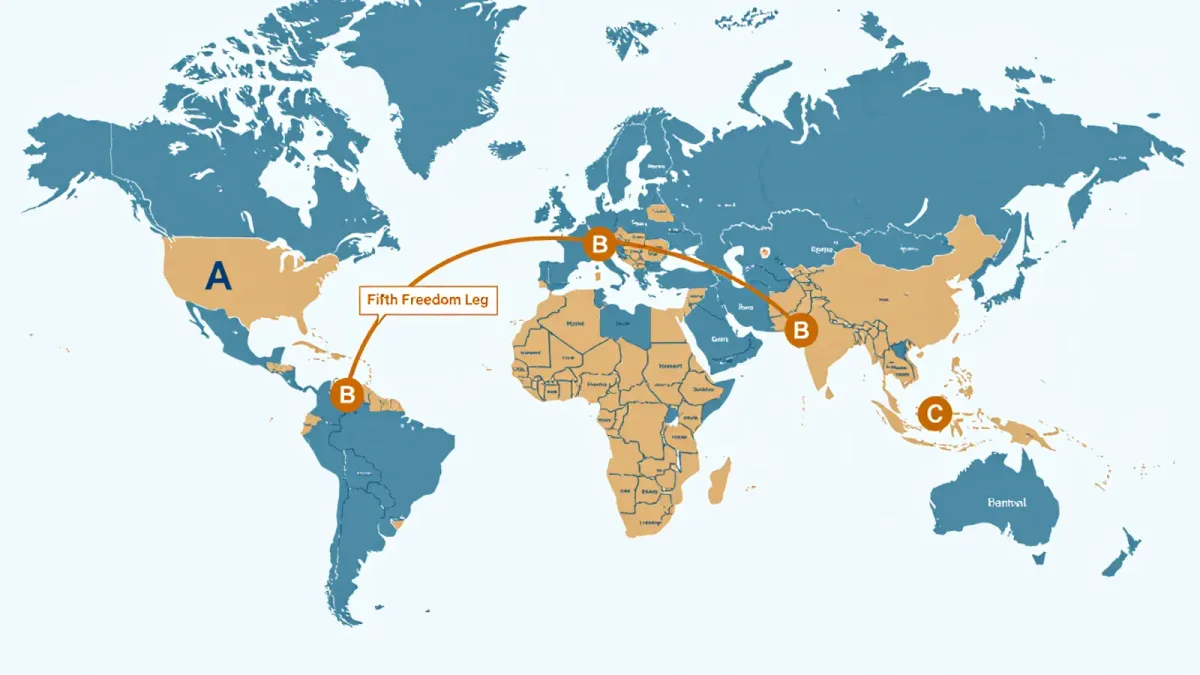
A fifth freedom flight is one where an airline based in country A carries passengers between countries B and C, neither of which is its home market — a right granted under bilateral air service agreements. The classic shape: an airline flying its home route A-to-C extends the aircraft to D, selling the B-C segment to anyone willing to board a foreign carrier on a route between two foreign points.
These routes occupy a small share of global flying but a large share of aviation lore, because they let travelers fly a foreign carrier's product on an itinerary no domestic airline would offer. This guide explains where the rights come from and what they mean at the fare screen. AGLA News publishes information, not travel advice; specific routes change with each agreement's renewal.
Where do the freedoms come from?
The 1944 Chicago Convention produced a list of commercial traffic rights, numbered first through ninth, that air service agreements grant pairwise between countries. The first freedom is overflight; the second, technical landing; the third and fourth, carrying traffic between the two signatories — the core of ordinary international service. The fifth freedom adds the right to carry traffic between two foreign countries on a route that begins or ends in the carrier's home country. Later freedoms cover standalone foreign operations and beyond, but the fifth is the one travelers most often encounter, and each instance exists only because the two countries served wrote it into their bilateral agreement with the carrier's home state — which is why fifth freedom routes appear and disappear as treaties are renegotiated.
Related stories: What an ACMI Wet Lease Is and Why Airlines Fly Other Airlines' Planes · Why Airlines Overbook Flights and What Denied Boarding Compensation Pays.
Why do airlines want these routes at all?
The economics come from aircraft routing, not segment revenue. A long-haul aircraft flying home-country-to-destination often cannot fill a day productively on one leg alone; extending the route to a fifth-freedom point spreads the aircraft's fixed cost across more block hours and opens a new traffic feed. The fifth-freedom segment also lets a carrier place its product in a market its own country cannot serve nonstop — a premium product audition in front of high-yield traffic. For travelers, the arithmetic produces cheap premium seats on some famous segments: competitive pressure on fifth freedom routes, where the foreign carrier undercuts the local incumbents to build presence, has repeatedly produced business-class bargains on routes otherwise priced at the top of the market.
What are the best-known examples?
The pattern repeats on several continents. Asian carriers hold a cluster of famous rights: Singapore Airlines has operated fifth-freedom legs between Southeast Asian cities and on transatlantic routings through Europe; Emirates, Qatar and Etihad extend Gulf routes into Europe and beyond, selling the foreign segments; and Japanese, Korean and Chinese carriers carry traffic on U.S. domestic-link legs such as Tokyo-Seoul or Seoul's U.S. gateway hops under their bilateral rights. Within Europe, the framework differs — the EU single aviation market grants cabotage-like rights internally — so the striking fifth freedom examples concentrate on intercontinental routes. The inventory changes constantly as bilaterals are revised, so the live source is the airline's own schedule, not a standing list.
What should a traveler know before booking one?
Three practical points. First, the product is the foreign carrier's — seat, service and loyalty program all belong to the fifth-freedom operator, which is exactly the appeal: a top-rated long-haul product on a short regional fare. Second, protections follow the operating carrier and the ticketing rules of the agreement under which the flight operates; delay and rebooking obligations can differ from the local incumbent's. Third, schedule risk runs higher than on trunk routes: fifth freedom segments hang off a long-haul rotation, so when the mother flight is retimed or the bilateral renegotiated, the segment moves or dies with it. Book the fifth freedom for the product and the price, not for schedule resilience.