
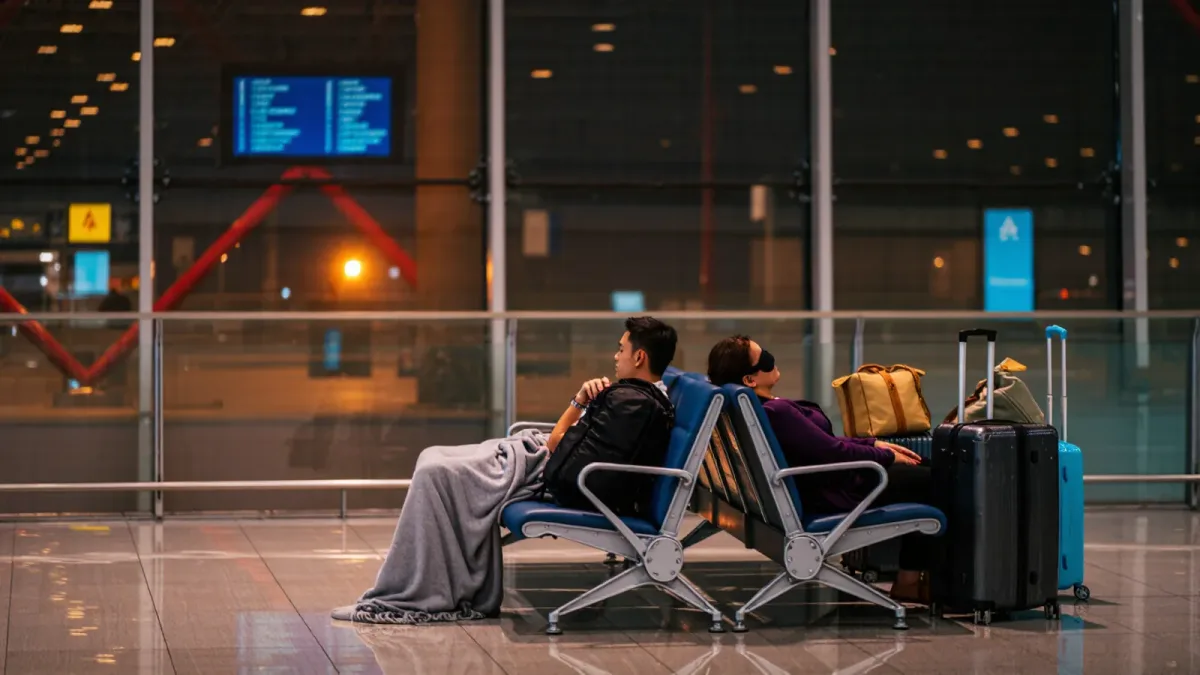
Most large international airports now offer at least one of three sleeping options: free seating airside, paid sleep pods or lounges at $30-80 for a block of hours, and transit hotels inside or beside the terminal at $100-200 a night. Which one works depends on a single question that decides everything else — whether the traveler can stay airside overnight or must exit through security and passport control when the last flight departs.
Sleeping in an airport is a logistics problem, not an adventure. The airports that tolerate it publish quiet-zone maps; the ones that do not close the terminal between the last and first departure. This guide covers how to read a terminal for overnight viability, what each paid option actually includes, and the failure modes that ruin an otherwise fine plan. AGLA News publishes information, not travel advice; rules vary by airport and change without notice.
Can you stay airside overnight?
At major 24-hour hubs in Asia and the Middle East, yes: terminals run all night, rest zones with reclined loungers are signposted, and landside attractions matter little. At many U.S. and European airports, no: security and passport control close overnight, and everyone without a departing red-eye is swept landside around midnight. The check is procedural, not anecdotal — the departure board after 23:00 tells the story. If it shows departures through the night, the terminal stays open and airside sleeping is viable. If the last departure is 22:30 and the first is 06:00, plan for landside options or an airport hotel with a landside entrance.
What do paid options actually cost?
- Sleep pods and capsule units: roughly $25-50 for the first hour-block and $10-20 per additional hour, offering a bed-sized berth, power, and blackout privacy inside the terminal.
- Pay-in lounge with reclining seating: $50-80 entry, sometimes including showers and food; quality varies, and seating is armchair-grade rather than flat.
- Transit or landside airport hotels: $100-200 a night, with shuttle or walkway access; transit hotels airside require a boarding pass for the next day's departure.
- Free: bench, floor carpet strip, or the armrests removed from armrests removed — costless but unguaranteed, and increasingly managed by rest-zone rules.
Related stories: TSA PreCheck, CLEAR and Global Entry Compared: Which Security Program Fits Your Travel · How Much Connection Time You Really Need at a Connecting Airport.
Which free tactics actually work?
Scout before dark. The reliable free spots share three traits: carpet or no armrest benches, distance from cleaning routes and announcements, and ambient light that dims after midnight. Departure-level corners above check-in halls, quiet zones near distant gates, and the corridors by interfaith rooms and chapels are perennial picks. Earplugs and an eye mask do more than any location choice — announcements and cleaning equipment are the two noise sources no location escapes. Keep valuables in the sleeping bag liner or zipped against the body; airports are public buildings, and thousands of people pass through overnight even in terminals that feel empty.
When is the hotel the right answer?
Any time the layover exceeds eight hours or the sleep quality directly gates the next day — a morning connection after a transatlantic arrival is the classic case. The arithmetic: a $140 hotel room buys roughly seven hours of protected sleep, which a free terminal spot often cannot, and the cost per protected hour of $20 is below what most travelers pay for any other hour of their trip. For layovers between six and eight hours with a confirmed airside terminal that stays open, a pod reservation at $40-70 splits the difference with guaranteed privacy at half the price.
What ruins an airport sleep plan?
Three failure modes dominate. First, the terminal closes overnight despite online claims — airport websites lag, and social media posts age badly; the departure board is the only live source. Second, the next morning's flight departs from a different terminal across a landside transfer that does not start until 05:00, turning a comfortable night into a missed check-in. Third, baggage: checked luggage is impossible overnight, so sleeping airside means carrying everything, which argues for a pod with lockable storage or a hotel where bags can be secured. Planning for those three, more than any specific gear, is what separates a workable overnight from a bad one.