
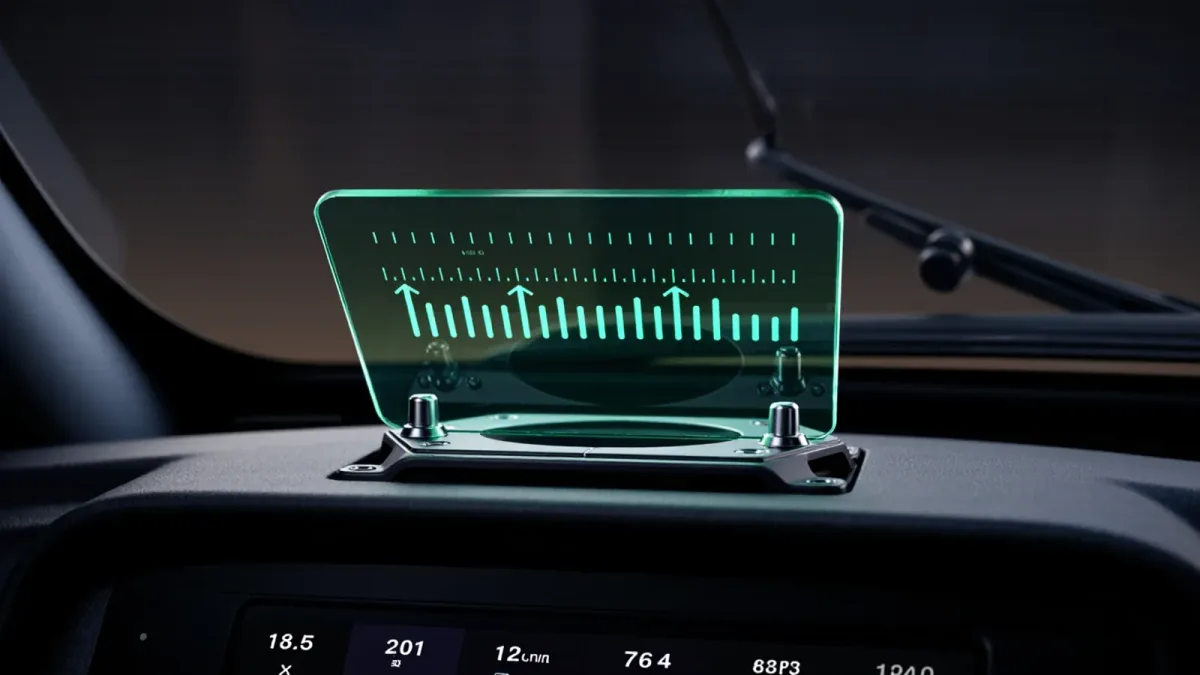
A head-up display (HUD) projects essential flight data — airspeed, altitude, heading, and a synthetic flight path vector — onto a transparent glass panel in the windscreen, aligned so the information appears to float over the real world ahead. The pilot flies the approach while looking forward, matching a glowing flight-path marker to the runway rather than looking down at instruments and back up. First proven in military cockpits, the HUD entered civil service in the 1980s-1990s and is now standard or optional equipment across the Airbus and Boeing widebody and narrowbody lines, per the manufacturers' flight-deck documentation.
Why is seeing data outside the windscreen safer?
Attention capture is the core argument. In the final approach phase, a pilot on instruments alternates between scanning inside gauges and looking outside for the runway environment — a transition that takes measurable fractions of a second each time, precisely when altitude and energy margins are smallest. The HUD collapses that alternation: the guidance sits in the pilot's forward view, so the eyes never leave the outside world.
The operational payoff shows in low visibility. Aircraft certified for HUD-guided approaches can fly to lower landing minima than the same type without one, because the display provides continuous, precise guidance down to the runway — some carriers fly HUD-based approaches to visibility minima their fleets could not otherwise use, converting weather days into on-time arrivals. Runway-overrun and approach-stability studies by safety bodies, including work published by the Flight Safety Foundation, associate HUD use with fewer unstabilized approaches.
Related stories: How In-Flight Wi-Fi Works: Air-to-Ground, Ku-Band and Ka-Band Satellite Explained · How Fly-by-Wire Works: The Computers Between Pilot and Control Surface.
What does a pilot actually see on a HUD?
The symbology is compact and standardized: airspeed on the left, altitude on the right, heading along the top, and the flight path vector — a small circle with wings — in the center, showing where the aircraft is actually going. On an instrument approach, a guidance ladder and runway cue overlay the real horizon; in enhanced-vision systems, an infrared sensor feeds a live image of the terrain onto the same combiner, letting crews see runway lights through darkness and haze that naked eyes cannot penetrate.
The hardware is minimal: a projector unit above the pilot, the glass combiner, and a processing computer fed by the same avionics that drive the main displays. The pilot's view through the combiner is undimmed daylight; the symbology is bright enough to hold against a sunset or a snow squall.
Which aircraft have HUDs, and does it matter to travelers?
Hud-fitted types span the market: every Airbus widebody carries one for the captain as standard, Boeing offers HUDs on the 737, 777, and 787, and regional jets increasingly carry them, per the manufacturers' equipment literature. Airlines order them chiefly for the operational credit — lower minima and fewer weather diversions.
That is the traveler connection: an airline flying a HUD-equipped fleet into a fog-prone airport keeps an approach option that a non-equipped aircraft must forgo. When winter fog closes other airports and one carrier keeps landing, the difference is often certified equipment — the HUD and its lower minima — rather than luck.