
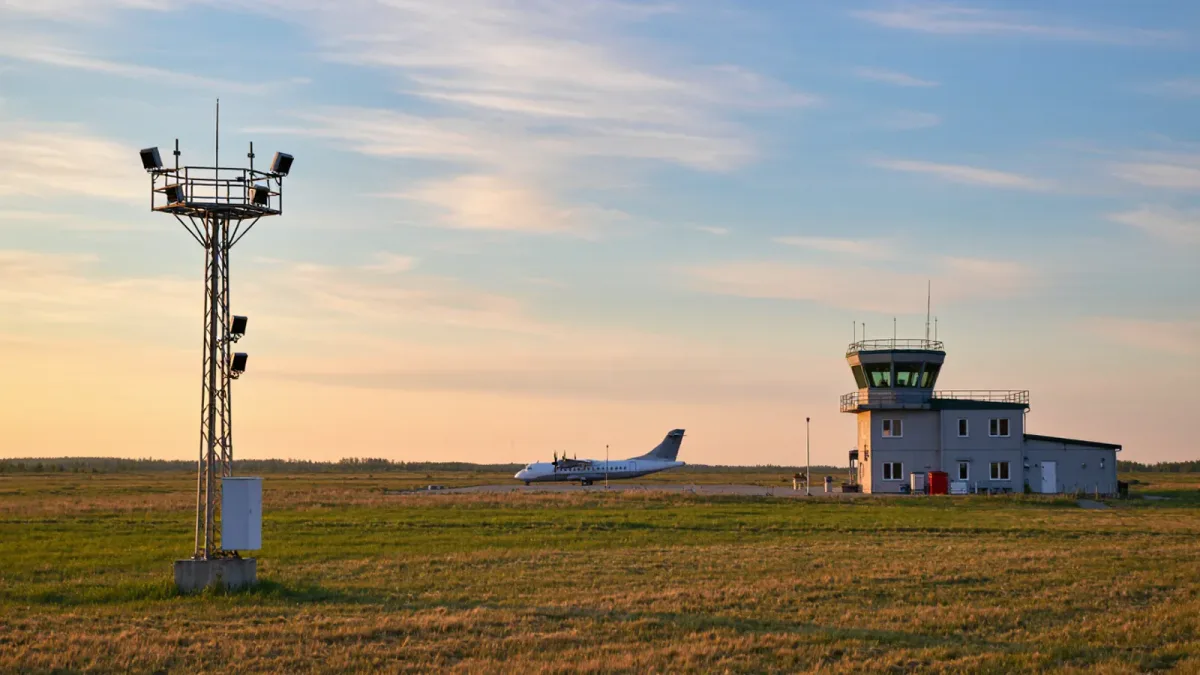
A remote digital tower is an air traffic control facility that provides live aerodrome control without a physical tower at the airport: an array of high-resolution cameras, pan-tilt-zoom units, and sensors on a mast streams a synthesized panoramic view to screens in a center that may sit hundreds of kilometers away, where controllers issue the same clearances they would from a cab. The concept is certified for live traffic at dozens of airports — Norway's Bodø center alone controls multiple airports remotely, and London City became the first major international airport controlled remotely from a center 130 kilometers away, per ANSP program documentation from Avinor, LFV, IAA, and NATS.
How does a controller see the airport without windows?
The view comes from a mast-mounted camera array at the airport. Software stitches several fixed high-resolution cameras into a smooth 180-or-360-degree panorama; controllers call up pan-tilt-zoom views of specific aircraft on a second screen, and overlays can show aircraft labels, weather data, and flight-plan strips on the image itself. Low-light and infrared sensors keep the picture usable at night and in fog, and the digital feed never suffers the glare, rain-smeared windows, or oblique sightlines of a physical cab.
The audio environment replicates the radio and ground-interphone lines of any tower. What changes is the geography: the controller's perception now travels over redundant fiber links with latency measured in milliseconds, and certification requires the system to keep functioning through link or power failures.
Related stories: How In-Flight Wi-Fi Works: Air-to-Ground, Ku-Band and Ka-Band Satellite Explained · How Biometric Boarding Works: Face Matching From Curb to Cabin Door.
Why do airports choose remote towers?
Economics and resilience, in that order. Small airports that could not justify staffing a physical tower around the clock can share controllers across several fields from one center — a single controller or team works two low-traffic airports alternately, as the Scandinavian centers demonstrate. Night shifts and breaks are covered by colleagues in the same room, and one maintenance crew supports all the camera masts rather than a building at each field.
Larger airports buy different benefits: the same panorama can feed approach facilities, digital feeds support contingency control if a physical tower is evacuated, and London City's case added capacity headroom without constructing a new cab, per NATS's published program descriptions.
What is the certification path, and what is next?
Regulators certify remote towers against the same separation and safety objectives as physical ones, with specific requirements for display latency, camera coverage, and degraded modes — the UK CAA approved London City's operations, and EASA has issued guidance material for member states. The United States has run demonstrations through the FAA's technical center but had not certified a remote tower for commercial traffic as of early 2026, per FAA program materials.
The trajectory points to hybrid operations: camera panoramas supplementing — then partially replacing — out-the-window views at towers of every size, with the controller's job shifting from looking to supervising a richer sensor picture. For travelers the change is invisible by design: same clearances, same radio calls, from a room that could be a country away.